
DWB publishes landmark report ‘The Reuse Dividend’
FOR IMMEDIATE RELEASE: 14 APRIL 2026
THE REUSE DIVIDEND: HOW BRITAIN'S EMPTY BUILDINGS CAN REBUILD COMMUNITIES AND DRIVE ECONOMIC GROWTH
Cross-industry group launches landmark international study showing how other countries are unlocking billions from building reuse - while Britain's tax system holds it back
Across Britain, the story is a familiar one. A once-busy department store standing empty in the middle of town. A Victorian school that nobody has used for a decade. A row of flats above shops that have been waiting for new life for years. A former pub, a former bank, a former post office - all sitting idle, full of potential, in communities that have the appetite and the ambition to make the most of them.
However, the UK’s current tax framework is actively undermining the financial viability required to enable the reuse of buildings.
Today, in Westminster, a cross-industry group of developers, architects, financiers, engineers and heritage experts is launching a major new international study that asks one simple question: why is Britain one of the few developed economies in the world failing to unlock the extraordinary potential of these buildings?
The answer, the study finds, is both simple and fixable.
THE REPORT
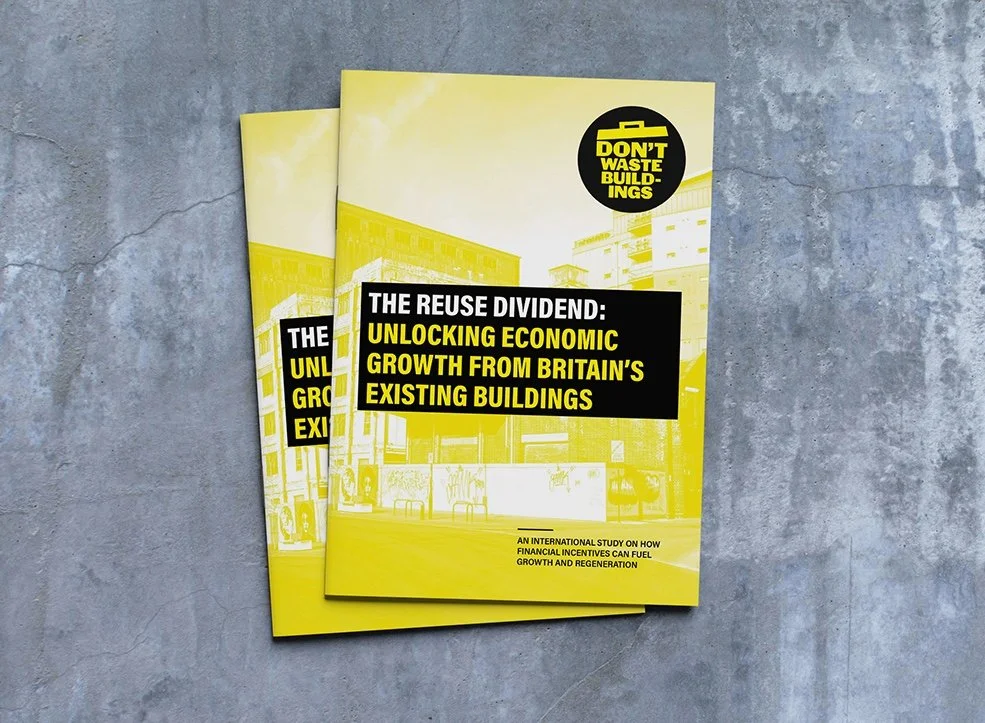
Click image to download report PDF
The Reuse Dividend: Unlocking Economic Growth from Britain's Existing Buildings (download report PDF), published today by Don't Waste Buildings, analyses the financial incentives deployed by eight developed economies which have driven building reuse at scale: France, Germany, the United States, Ireland, Canada, the Netherlands, Belgium, and Italy. The study examines both the successes and the lessons learned, identifying a clear and proven blueprint for Britain to adopt.
The findings are striking. Country after country has recognised that its existing buildings are not problems to be disposed of through demolition but economic and social assets of enormous value. They have introduced intelligent financial incentives to bring them back into productive use, and reaped significant returns in jobs, growth, housing, and community regeneration.
Britain has not. And it is paying a heavy price.
WHAT THE UK SHOULD DO NOW
Based on its analysis of eight international models, Don't Waste Buildings is calling on the UK Government to introduce four complementary measures:
Level the VAT playing field — Reduce or zero-rate VAT on repair, maintenance and renovation to bring existing buildings back into use, in line with France's proven model. The single most impactful change available, deliverable in a single Budget
Introduce tax credits for reuse — Capital gains tax relief and Stamp Duty discounts for the purchase and reuse of vacant buildings, and tax credits for the use of reclaimed materials, following the US model
Create targeted grants for vacant buildings — A direct grant programme modelled on Ireland's highly successful scheme, specifically targeted at Britain's declining high streets and town centres
Establish subsidised finance for deep reuse — Long-term, low-interest loans through the National Wealth Fund, linked to achieving high performance energy standards, following Germany's KfW blueprint
Lead author Richard Nelson, Co-Founder of Don't Waste Buildings, said:
"The evidence from France, Germany, the US, Ireland and the other countries we’ve looked at is clear.
“The building reuse programmes that have made the biggest difference are the ones creating long-term structural change while also focused on local communities to drive economic growth.
“Places where a single empty building on a main street can define whether that street feels alive or forgotten. Britain has more of those buildings, and more of those streets, than almost any comparable country. The opportunity is extraordinary. The only thing stopping us is the way we tax it."
THE OPPORTUNITY HIDING IN PLAIN SIGHT — EVERYWHERE, NOT JUST LONDON
This is not primarily a London story. It is a story about every town, every high street and every community across the United Kingdom.
There are currently more than one million empty buildings across Britain. According to Historic England, 670,000 new homes could be created simply by bringing vacant historic properties — buildings over 100 years old — back into use. These buildings are not concentrated in the capital. They are in Burnley and Bradford, in Stoke and Swansea, in Dundee and Doncaster, in coastal towns and market towns and post-industrial cities that have the potential to thrive again.
Every one of those empty buildings represents a family that could have a home, a community that could have its heart back, a high street that could have a reason to exist. And every one of them is sitting idle — in part because the British tax system makes bringing them back to life significantly more expensive than simply knocking them down and starting again, a scenario with high environmental as well as economic costs due to the significant carbon price of building new.
THE ABSURDITY AT THE HEART OF THE SYSTEM
Under current British tax law, building a brand-new home is taxed at zero percent VAT. Reusing, repurposing or bringing back to life an existing building is taxed at the full 20 percent rate. This disparity dates back to the introduction of VAT in 1973 — a policy designed for a different era, with different priorities. Nobody designed it to penalise building reuse. But that is precisely what it does. Its consequences are felt every day in every community in the country. It makes the wasteful demolition of a perfectly sound building cheaper than saving it. It punishes the developer who wants to convert an empty office into flats. It penalises the community group trying to repurpose a vacant and deconsecrated church. It actively discourages exactly the behaviour that would benefit communities, cut carbon emissions and deliver the homes Britain desperately needs.
Will Hurst, Co-Founder of Don't Waste Buildings and Managing Editor of The Architects' Journal, said:
"Most people reuse things every day. We buy second-hand cars. We shop in charity shops, on eBay and on Vinted. Reuse is an inherently good thing and reusing buildings is the same common sense applied at a bigger scale — with even bigger rewards for communities and for the climate. The extraordinary thing is that Britain has quietly and perhaps unwittingly built a tax system that punishes people for doing it."
WHAT OTHER COUNTRIES ARE DOING — AND EARNING
The report's international evidence is compelling:
Click to enlarge
France reduced the VAT rate on bringing existing buildings back into use from 20% to 10% — and to just 5.5% for energy efficiency improvements. The result is a building reuse market worth €45 billion every year, supporting hundreds of thousands of jobs, many of them in small and medium-sized businesses in towns and cities across the country. A critical side benefit: lower VAT rates make the formal, tax-paying route more attractive than cash-in-hand work, bringing billions of Euros worth of economic activity into the legitimate economy and increasing overall tax receipts.
The United States introduced a 20% tax credit for the reuse and rehabilitation of historic buildings more than 40 years ago. It has since leveraged more than $109 billion in private investment. An independent study found the programme generates $1.20 to $1.25 in federal tax revenue for every single dollar of credit issued. It creates approximately 75,000 jobs annually — predominantly in smaller cities and towns where historic building stock is concentrated.
Germany uses its state-owned KfW bank to offer low-interest loans and repayment grants for bringing buildings back up to high performance standards. Every €1 of public funding unlocks €6-7 of private investment, it is estimated. The programme stimulates €40-50 billion in private investment annually and supports an estimated 300,000-400,000 jobs per year.
Ireland introduced direct grants of up to €70,000 for individuals bringing vacant and derelict buildings back into use as homes. The results are visible in towns and villages across the country — buildings that were eyesores and liabilities for years are now family homes, with residents spending money in local shops, paying local taxes and restoring local pride.
Leanne Tritton, Co-Founder of Don't Waste Buildings said:
"The French model is the one that gives the greatest optimism for Britain. France made one fundamental change – reducing the VAT rate on bringing existing buildings back into use – and the results have been extraordinary. A building reuse market worth €45 billion a year, hundreds of thousands of jobs, and buildings brought back to life in towns and cities right across the country. Not just in Paris. In places that face exactly the same challenges as the market towns and coastal communities of Britain. One change to the tax system delivered all of that. We could have the same story here and we could have it within this Parliament."
HOUSING, JOBS AND THE HIGH STREET
The report argues that a serious programme of building reuse would deliver across multiple dimensions simultaneously and that the benefits would be felt most powerfully outside of London and the South East.
On housing: Even if only half of the 670,000 homes identified by Historic England within vacant historic properties prove viable, that represents a transformational contribution to the Government's target of 1.5 million new homes — delivered on well-connected brownfield land, without building on a single green field, without years of planning disputes, and in the communities that need housing most urgently.
On high streets: Every empty building brought back to life changes the character of a street for the better. It brings footfall. It supports neighbouring businesses. It signals that a place has a future. The cumulative effect of hundreds of buildings being reused across a town centre is transformational as communities in France, Ireland and Germany demonstrate.
Matt Bullivant, Financial & Tax Incentives Lead at Don't Waste Buildings, said:
"The economic argument for fixing this is overwhelming. The international evidence shows consistently that well-designed incentives for building reuse pay for themselves — through increased tax receipts, job creation and a larger, more formalised economy. This is not government expenditure. It is strategic investment with a proven positive return. The question for the Treasury is not whether we can afford to do this. As eight other developed economies demonstrate, the question is whether we can afford not to."
THE CLIMATE CASE
The environmental argument for this approach is equally compelling. The carbon emissions associated with demolishing an existing building and constructing a new one account for a significant and largely invisible share of Britain's total carbon footprint. Reusing a building instead typically saves 50-75% (PDF) of this upfront carbon — carbon that would otherwise be released into the atmosphere immediately, at the very moment when every tonne counts most.
At current rates, the UK will exhaust its remaining carbon budget as early as 2027. Building reuse is one of the fastest and most cost-effective tools available to avoid that outcome.
NOTES TO EDITORS
About us
Don't Waste Buildings is a UK-founded cross-industry voluntary campaign group advocating for the large-scale reuse and repurposing of existing buildings as a primary source of new homes and regenerated communities. Non-party political and led by a core group of property developers, financiers, architects, engineers and heritage experts, the group has grown to more than 2,300 members. www.dontwastebuildings.com
About the Report
The Reuse Dividend: Unlocking Economic Growth from Britain's Existing Buildings is available to download in full at www.dontwastebuildings.com. The report was supported by Elliott Wood, BGY and Scott Brownrigg.
Key Statistics
1 million+ empty buildings in the UK (Action on Empty Homes) 670,000 homes could be created within vacant historic properties (Historic England) 20% VAT on building reuse vs 0% VAT on new build (RICS) France: €45 billion annual building reuse market underpinned by reduced VAT USA: $1.20-$1.25 returned to Treasury for every $1.00 of tax credit issued; 75,000 jobs annually Germany: every €1 public investment unlocks €6-7 private; 300,000-400,000 jobs annually Reusing a building saves 50-75% of upfront carbon versus demolition and new build UK will exhaust its carbon budget by 2027 at current rates Building reuse creates 50% more jobs than new construction per pound spent UK circular economy growing 3x faster than the overall economy
Spokespeople Available for Interview:
Richard Nelson, Co-Founder, Don't Waste Buildings
Will Hurst Hon FRIBA, Co-Founder, Don't Waste Buildings; Managing Editor, The Architects' Journal
Leanne Tritton Hon FRIBA, Co-Founder, Don't Waste Buildings
Matt Bullivant, Financial & Tax Incentives Lead, Don't Waste Buildings
Contact info@dontwastebuildings.com
A NOTE FOR REGIONAL AND LOCAL MEDIA
Don't Waste Buildings is particularly keen to speak with regional and local media about the specific opportunity in their area. Empty buildings, vacant high streets and underused historic properties are a national issue felt most acutely outside London. Spokespeople are available to discuss the specific implications for towns, cities and communities across England, Scotland and Wales. Please contact info@dontwastebuildings.com to arrange.
This press release is issued under embargo until 00:01 on Monday 14 April 2025. Please do not publish, broadcast or post online before this time.
Don’t Waste Buildings is grateful for the support of Elliott Wood, Scott Brownrigg, BGY and the Architectural Heritage Fund in helping to launch this report, and Serjent Design for the design and artwork.